Before the Leisure Centre: Where People Gathered for Recreation
Before the leisure centre, streets, parks, halls and reading rooms offered different ways to gather. See how their rules shaped recreation and access.
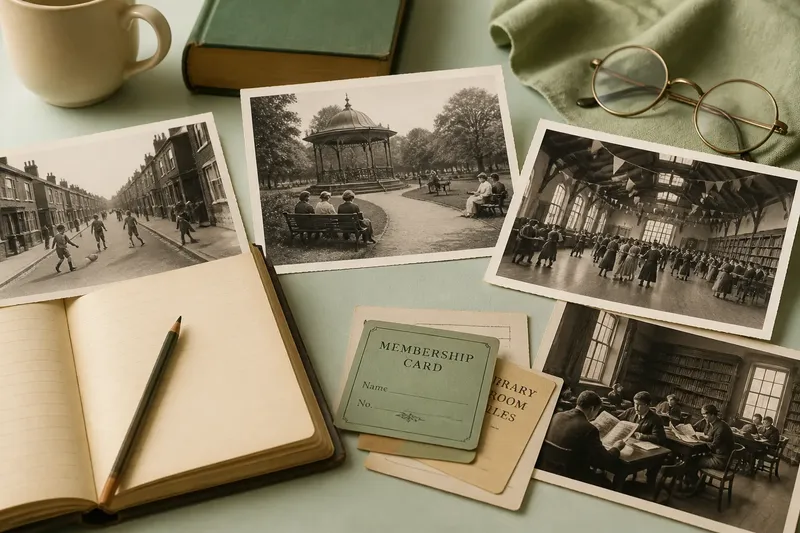
Before the leisure centre, recreation happened in streets, parks, halls and reading rooms, each with its own terms of access. In Britain, these settings did not form one uniform historical sequence: their use varied by town, period and local rules, so it is more useful to compare what each place allowed than to imagine a single path from informal play to organised facilities.
Streets and play
A street could serve as a play space because it was already part of everyday movement. Children might use kerbs, doorways or a clear patch of ground for games, while neighbours paused to talk. These activities sat alongside errands and travel rather than requiring a separate venue.
Whether a street felt available depended on its conditions and on how people used it. A quiet lane might invite lingering; traffic, disputes or local restrictions could make play unwelcome. The same route could be a meeting place for some and a place to pass through quickly for others.
Street recreation was visible, which could bring disagreement as well as company. A game’s noise or use of shared ground might be accepted by some neighbours and challenged by others. Looking at a particular street therefore means asking who used it, what activity took place and what boundaries applied.
Parks and promenades
Parks offered a setting where walking, sitting and meeting could be recognised as uses of public space. Paths, lawns and planted areas shaped what visitors could do; a promenade encouraged a measured walk, while open ground could suit more active play.
Access and conduct were not identical from one park to another. Gates, opening times, signs and local rules could set limits, and the location of a park affected who could readily reach it. A green space might welcome many visitors without making every activity acceptable in every part of the grounds.
Parks also made room for recreation that did not require a club or scheduled event. Someone could stroll, watch others or meet an acquaintance without taking part in organised sport. The layout acted a little like furniture in a shared room: it suggested where to sit or move, without making every visitor do the same thing.
Halls and assembly rooms
Halls and assembly rooms brought gatherings indoors, where organisers could arrange dances, concerts, talks, amateur performances or celebrations. The same floor could be cleared for dancing or furnished with rows of chairs for an audience.
That flexibility depended on decisions about booking, timing and the event itself. Organisers chose what went on the calendar and how the space would be arranged, making recreation more planned than an informal meeting in a park. A hall could serve different groups in turn, but its schedule determined when each could use it.
Some accounts of recreation mention halls without identifying a particular building or place. In those cases, it is safer to treat the hall as a type of shared venue, not as evidence that every town followed the same pattern. A local history, building record or event notice can establish who used a specific room and when.
Reading rooms and libraries
Reading rooms offered a quieter kind of shared leisure. Newspapers, books and a place to sit could bring people into one room without requiring conversation or a common activity.
Rules about noise, borrowing and conduct shaped the experience, as did decisions about who could enter and what material was available. The room’s social quality came partly from proximity: readers could pursue separate interests while sharing a place.
Libraries and reading rooms have differed across communities and periods, so the name alone does not settle how open a particular institution was. Local rules and records are better guides to its hours, users and lending arrangements.
Clubs and membership
Clubs gathered people around continuing interests such as music, games or debate. Regular meetings and a familiar room could help members organise activities that needed equipment, shared arrangements or a dependable group.
Membership also drew a boundary. Unlike a public park, a club might require an invitation, subscription or affiliation, and its customs could be unfamiliar to newcomers. A dedicated space supported continuity, but did not necessarily make participation widely accessible.
For that reason, comparisons between a club and a public hall should focus on the conditions of entry as well as the activity. A hall might host changing groups; a club usually returned to the same community of members. Neither description, by itself, tells us who was included in a particular place.
Specialised recreation
Some venues were designed around particular activities, such as swimming, field games or indoor sport. Their layouts and equipment could make those activities easier to organise, while rules and designated areas shaped how visitors took part.
Specialisation did not mean that streets, parks or multipurpose halls vanished. It added another option, often with a more defined programme or entry condition. The difference is best understood locally: a purpose-built venue might expand opportunities for one activity while offering less room for casual, mixed-use gathering.
Imagine an invented neighbourhood hall that hosts dances, chess evenings and local talks in one room. Its organisers then assign separate rooms to each activity and publish a fixed timetable. The observable result would be clearer arrangements for regular groups, but fewer chances for a passer-by to discover an event simply by entering the hall; the trade-off is convenience for participants against some spontaneity for visitors.
Questions about recreation spaces?
What counted as recreation before leisure centres?
Recreation could include informal play, walking, reading, dancing, performances and club activities. The setting might be an ordinary street or a room arranged for a planned gathering.
Why did parks matter?
Parks provided places for walking, sitting and meeting outside the home. Their paths, facilities and rules influenced which activities felt welcome and where they could take place.
How did clubs differ from halls?
A hall could host different events for different groups, while a club generally brought members together around an ongoing interest. The club offered continuity but usually had a more defined boundary around participation.
Did specialised venues replace informal places?
Not as a single, universal change. Purpose-designed facilities added options, while streets, parks, halls and reading rooms continued to support activities that needed little equipment or formal organisation.
Reading local evidence
To understand a particular gathering place, start with its location and the period you are considering. Then look for practical evidence: opening rules, event notices, membership requirements, building plans or local accounts. These can distinguish a general possibility from a documented use of a named venue.
Before the leisure centre, people gathered in places with different degrees of formality, privacy and access. The phrase “before the leisure centre” is therefore most useful when it prompts a local question: who could enter, what could they do, and under what conditions? Those details reveal a venue’s role more clearly than its name alone.