The Myth of the Perfect Hobby Match
The perfect hobby match is rarely obvious at the start. A short, deliberate trial can show whether to adjust the setting, change the activity or move on.
The perfect hobby match is rarely obvious before you begin. A short trial can tell you whether an activity itself feels wrong or whether its timing, company, cost or surroundings are getting in the way.
That distinction matters because early awkwardness is easy to misread. A beginner at a pottery class may dislike the crowded room and hurried pace, not working with clay; someone who tries sketching alone may discover that what they miss is a group. Treat a pastime as a possibility to investigate, not a lifelong choice to get right on the first attempt.
When the activity is unfamiliar
If you cannot yet picture what a pastime feels like in practice, choose a short, low-commitment introduction. Borrow a ukulele, attend a taster session, or follow a beginner’s drawing exercise with ordinary paper and pencils. The point is not to judge your talent. Notice whether the activity holds your attention once you understand what you are doing.
Keep the first trial modest enough that you can finish without turning it into a project. A complicated knitting pattern, specialist camera purchase or ambitious walking route can make the equipment and preparation feel like the pastime. Start with a simple scarf pattern, a phone camera or a familiar local path, then decide if you want more.
Say you are curious about birdwatching but find an initial outing dull. If you spent most of it trying to identify distant birds in heavy rain, that may say more about the conditions than your interest. A brief visit to a nearby park on a calmer day, with a basic field guide, gives you a fairer sense of whether watching and listening appeal to you.
When the setting feels wrong
If you like the central activity but dread the circumstances around it, change one part of the setting before giving up. Try a different time, venue, group size or level of structure. A book club in a busy café may suit someone who enjoys conversation but not noise; a quieter library group could make the same discussion more appealing.
Change one condition at a time where possible. If you move from an evening class in a large group to a daytime lesson with a friend, you may enjoy the new arrangement, but it will be harder to know which change helped. Think of it like moving a chair nearer a lamp: adjust the part that is making the task uncomfortable before replacing the whole room.
There are limits to this approach. If the setting is inconvenient in ways you cannot alter, such as a venue you cannot reach or a schedule that repeatedly clashes with care responsibilities, the pastime may not fit your life right now. That is a practical mismatch, not a failure of imagination.
When you enjoy it, then avoid it
Some pastimes feel absorbing once started but are difficult to begin. Look for friction before deciding you lack interest: equipment may be scattered, the next task may be unclear, or the activity may demand more time than you usually have. Set out the sketchbook, recipe or gardening gloves where you can see them, and leave the next small action obvious.
If preparation is the obstacle, reduce the setup rather than lowering your expectations of enjoyment. A person who likes baking might choose a simple loaf on a free afternoon instead of planning an elaborate cake after work. If even a convenient, manageable session feels like something to endure, that is useful evidence too.
Enjoyment does not have to mean constant excitement. A pastime may offer calm, concentration, physical movement or the pleasure of learning. Ask what you wanted from it and whether you received any of that, rather than comparing it with someone else’s enthusiasm.
When company changes the experience
Some activities are best alone; others become more inviting through shared attention. If a solitary attempt felt flat, try a class, club or session with a friend before ruling out the activity. Conversely, if a group makes you self-conscious or forces a pace that does not suit you, repeat the activity privately.
Do not assume that a group’s atmosphere is the activity’s natural character. A competitive board-game night can make a thoughtful strategy game feel tense, while a relaxed table with patient players may suit it better. Ask whether the people around you leave room for the kind of participation you want: conversation, quiet practice, friendly challenge or a shared result.
When the first trial disappoints
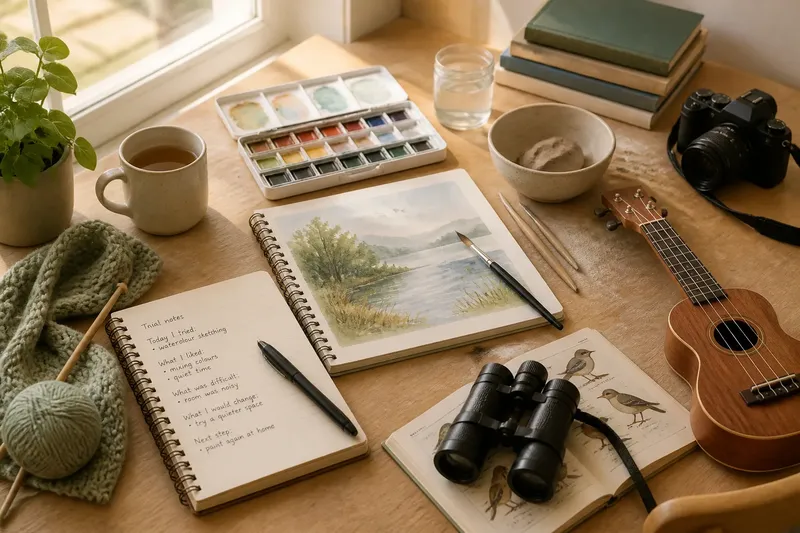
A disappointing session can come from several sources, so make a brief note soon afterwards. Record what you did, what felt enjoyable or draining, and what circumstance you would alter next time. Keep the note concrete: “liked choosing colours; room was noisy” gives you more to work with than “not for me”.
Then choose among three responses: repeat under improved conditions, try a different version of the same pastime, or stop. If the activity was interesting but the class was too advanced, look for a beginner group. If you disliked both the process and the result, there is little reason to keep investing time simply because you once thought it ought to suit you.
A useful trial has a clear boundary. Decide in advance what would make another attempt worthwhile, such as finding a quieter venue or understanding the basic rules. This prevents an exploratory hobby from becoming an open-ended obligation, while leaving room for your view to change as you gain familiarity.
Which choice fits your situation?
Should I try a hobby again if the first session felt awkward?
Try again if the awkwardness came from being new, unclear instructions or a setting you can change. Choose a smaller or more beginner-friendly session, then notice whether curiosity grows once the initial confusion eases.
What if I like the idea more than doing it?
That difference is worth taking seriously. If a brief, accessible trial leaves you uninterested in the actual activity, you can keep appreciating it from a distance and choose a pastime whose process suits you better.
How long should I give a new pastime?
There is no universal duration. Give it enough time to understand the basic activity, but set a modest boundary that fits your schedule and resources; extend the trial only if you have a specific reason to expect a different experience.
Should I choose a social or solitary version?
Choose based on what you want from the activity and what made the first attempt easier or harder. You can also alternate: practise photography alone, for instance, and join a local walk when you want company and conversation.
Let the choice stay provisional
The perfect hobby match is not a hidden answer you must uncover before beginning. It is often a workable combination of activity and circumstances, discovered through small attempts and sensible adjustments. A pastime can suit one season of life and not another, and leaving it aside need not erase what you enjoyed.
Before the next trial, name one thing you hope to experience and one condition you can control. That gives you a fair basis for deciding what to change, what to continue and what to release, without asking a leisure activity to prove that it belongs in your life forever.